St. Antony Shrine (St. Mary’s Co-Cathedral)
Church History
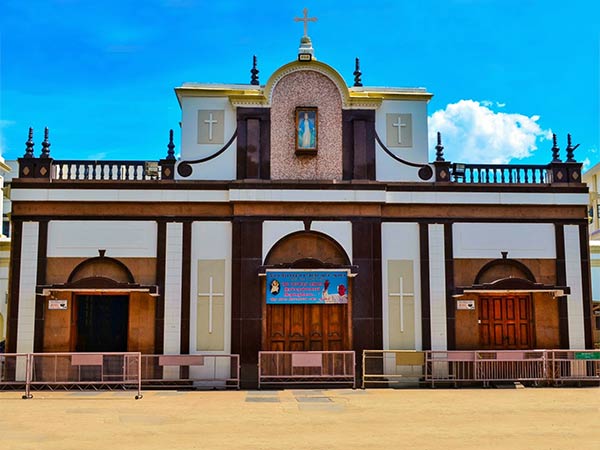
St. Mary’s Co-Cathedral Church is an ancient parish, dating its origin to the year 1775 had the biggest Catholic population (800 – in 1900). Now the Catholic population has come down to 235 parishioners – with 43 families. A big crowd of 5000 to 10000 devotees of St. Antony visit here every Tuesday. The Church is popularly known as St. Antony’s Church, because of the miraculous statue of St. Antony. People of different religions flock together from morning (5.a.m) till evening (11.30 p.m.). Even on weekdays, one could see a sizable number of devotees praying silently and fervently. This is almost like Ecumenical Church, bringing people of different faiths from all directions. The church is surrounded by commercial centres and hence the residential catholic people are dwindling. It has only a floating population.
St. Mary’s Co-Cathedral is a historic landmark in the city of Madras (renamed as Chennai today). It is a popular pilgrim centre in the heart of the city that attracts tens of thousands of pilgrims of all faiths-Christians, Hindus, Muslims and others-to pray and pays homage to Mother Mary and their favourite saint, St. Antony. People flock to the Church, especially on Tuesdays, the day dedicated to St. Antony, because they believe that their prayers are answered and they witness many miracles here.
St. Mary’s Church, was originally built in 1658. During the French occupation of Madras, the church suffered serious damages and so it was rebuilt in 1775 and enlarged further in 1785 on a modest scale. The Madras Catholic Directory makes mention of the church of St. Mary of Angels in 1857, with a Catholic population of 8,000, with the neighbouring St. Francis Xavier’s chapel as its substation. St. Mary’s first served as the Church of the Prefects of the Capuchin Missions at Madras and later became the Church of the Vicariate Apostolic of Madras in 1834. In execution of the Papal Bull “Humanae Salutis Auctor” of September 1, 1886. His Holiness Pope Leo XIII, by an “Apostolic Brief” (25-11-1886), promoted the Vicar Apostolic of Madras, Dr. Joseph Colgan, to the Archiepiscopal See of Madras and the Church of St. Mary’s of the Angels was raised to the dignity of the Cathedral Church. Finally, when the Archdiocese of Madras and the Diocese of Mylapore were combined into a new Ecclesiastical Unit, an Apostolic Constitution, “ExPimaevae Ecclesiae.” was issued on December 13, 1952, forming the new Archdiocese of Madras-Mylapore. St. Thomas Cathedral, Mylapore, was assigned as the Cathedral of the new Archdiocese and St. Mary of Angels as the Co-Cathedral.
Alterations And Enhancements
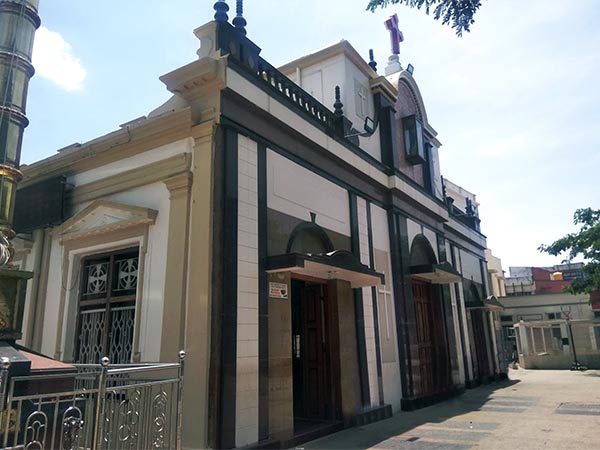
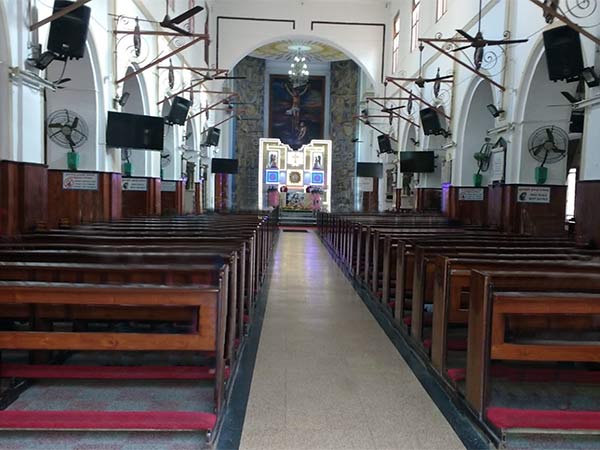
St. Mary’s church, though rich in history and tradition, is a simple structure, without any architectural pretensions. In 1871, Fr. Ferdinando sought permission to build a splendid structure in its place, worthy of its patroness. However, the engineer questioned the property of raising a high structure in the proximity of the Fort. Hence, Rev. Fr. Ferdinando had to be content with making some minor alterations. In 1931, Archbishop Mederlet SDB, without interfering with the façade of the church raised the walls of the middle aisle by four feet and replaced the old roof with a new concrete roof. A little later, Dr. Louis Mathias, SDB, Archbishop of Madras-Mylapore, carried out extensive repairs. In 1991, Rev. Fr. N.A. Joseph SDB, constructed a small hall in front of St. Antony’s altar, attached to the church, for the convenience of the thousands of devotees that flock to the shrine particularly on Tuesdays. The main façade of the Shrine was lined with polished granite in 2000, when Fr. Varuvel Jeromedhas SDB, was pastor, without tampering much with the original architectural design.
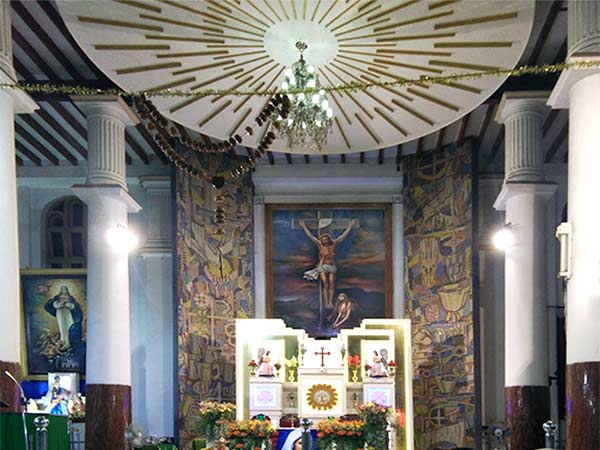
Rev. Fr. Arokiasamy Tharsius SDB, the present pastor, replaced the tiled-flooring of the hall in front of the altar of St. Antony and the sanctuary around the main altar with white tiles in 2001. In 2006, he further embellished the background of the main altar with a new exquisite design.
Congresses and Synods
St. Mary’s Co-Cathedral shared the honour of hosting the First Marian Congress in 1921 and National Eucharistic Congress in 1937 with the St. Thomas Cathedral, Mylapore. The first Provincial Council of the Archdiocese of Madras was held at St. Mary’s Cathedral on February 18, 1894. The Cathedral has also witnessed three Diocesan Synods including the significant Synod of 1942, that marked the third centenary of the arrival of the Capuchins in Madras and the fourth centenary of the arrival of St. Francis Xavier, the second Apostle of India, in Goa.
St. Mary’s Co-Cathedral has had the privilege of witnessing the concentration of Vicar Apostolics, Bishops and Archbishops. The mortal remains of many eminent Vicar Apostolics and Archbishops are interred here.
Records show that the Dedication of St. Mary’s was first celebrated on 8 October 1861 and continued ever since. The Cathedral had an unbroken succession Pastors since Fr. Ephraim de Nevers, the founder, till today. Fr. Arokiasamy Tharsius being his present successor. After changing many hands the shrine was finally handed over to the Salesians of Don Bosco in 1928, with Reg. Mgr. Mora, as the first Salesian Pastor. Ever since the Salesian Fathers have been taking care of the shrine.
St. Mary’s Co-cathedral was canonically raised to the status of an Archdiocesan Shrine by Most Rev. Dr. D.M. Chinnappa, SDB, DD, PhD, the Archbishop of Madras Mylapore, on September 8, 2005.
The History Of The Miraculous Statue of St. Antony
St. Antony is certainly one of the most popular and loved saints of the Church. All over the world, St. Antony attracts devotees not only from Christians but other faiths also.
There is an interesting story behind the miraculous statue of St. Antony venerated at St. Mary’s Co-Cathedral. It is believed that in 1929, a group of Goan sailors were caught in a storm that endangered their life. In great distress on the high seas, they pledged that, if they were rescued, they would present a statue of St. Antony to the nearest church from their point of landing. They were miraculously saved and true to their promise they commissioned some artists in Goa to make the statue.
“Why is this statue of St. Antony wearing a beard”? ask people, who have seen other statues or pictures of St. Antony clean-shaven. Presumably, because artists who made the statue had no models for inspiration and since all the Franciscan Missionaries they had seen wore beards, they assumed St. Antony too to be bearded. The statue was duly presented to the Parish Priest of St. Mary’s Cathedral. The Parish priest gave the statue to the Catechist of Park Town parish, saying that there was no place for the statue in the Cathedral. The Catechist placed the statue on a side altar and forgot about it.
Later on, the statue was removed and placed in the chapel of St. Patrick’s cemetery. Gradually, people began to notice the presence of the statue at the cemetery and few of them began to go there to pray before the statue of St. Antony. The number of devotees began to increase day by day as rumours of miracles spread. The church authorities closed an eye over the devotion until there was a fight between the cemetery watchman and the Catechist of Park Town Parish over the money collected there. It was brought to the notice of the Archbishop, His Grace Archbishop Louis Mathias, who ordered the Asst. Parish Priest of St. Mary’s, Rev. Fr. Schupp, to remove the statue from the cemetery and bring it to the parish house. The devotees who used to visit St. Antony’s statue at St. Patrick’s Cemetary Chapel, came to the Cathedral searching for their favourite saint. Not finding it there, they went to V. Rev. Fr. Mora, SDB, the Vicar General, requesting him to reinstate the statue in St. Mary’s Church. Their request was granted and the statue was brought back to St. Mary’s Co-Cathedral.
The devotion of St. Antony and veneration for this particular statue, “the bearded St. Antony” spread like wildfire. People of all faiths flocked to St. Antony with their prayers and petitions especially on Tuesdays, a day dedicated to the saint. The devotion continues to grow to this day. A countless number of his faithful devotees bears witness to the miracles and wonders their beloved saint works in response to their prayers.
Apart from the devotion of St. Antony, devotion to Our Lady of Perpetual Help also flourished side by side at St. Mary’s. The Co-Cathedral regularly conducts Novena to Our Lady of Perpetual Help twice a week – on Wednesdays in English and on Saturdays in Tamil. Both novenas are well-attended by the faithful.
Information
63/110, Armenian Street,
Parry's Corner - George Town,
Chennai - 600 001