Holy Rosary Basilica
Church History
It can be called ‘the cradle of the Coimbatore Diocese, just as Sathyamangalam can be called the Cradle of (Satyamangalam) and hence also of Coimbatore Mission. Historically, it can be discussed, whether Christianity existed here, even before the first Jesuit Missionary of Satyamangalam Fr. de Costa sowed the seed of faith in 1643. But Fr. Beschu, a historian in his own right, is of the view that Karumathampatty was a pilgrimage centre already in 1640, implying Christians were living here and a church existing even before 1643! Since it is the centre of the Christians of weaver’s caste (Devangas), who according to oral tradition, had migrated from Mangalore area( Sirisi) and if so, settled here probably, either already converted there by the Jesuits of Goa or, after settling here, they were evangelized by the Jesuits of Madurai. But according to Fr. C. S. Maria Arokiam, the first converts at Sathy were mostly from Sedar ( older name for Devangas) weaver’s community and that they formed the majority of the first converts during, the very beginning of the Christianity founded by Fr. de Costa (1643 ) and his successors Fr. Martinez and Arcolini. It is recorded that by 1658 there were 130 villages with 23 churches around Sathy within a radius of 60 miles and thus Karumathampatty was certainly a Christian centre by then. But ‘Karrumathampatty’ is specifically mentioned only in 1686. A priest was residing here during the Mysore and Tanjore war. There was a fort here with a church inside the fort and it was besieged by the Tanjore soldiers, but saved by the Mysore army. But it could be surmised that it was one of the 15 churches for 25 leagues (that would bring Coimbatore and Dharapuram within its ambit). Hence we can safely conclude that Christianity had already spread in the southern part of the Diocese. Erode and Karur is mentioned by the same Fr. de Costa, as already Christian colonies, when he was on his way to Sathy to start the mission in 1643. Thus it is safe to conclude that, though the official commencement of Sathy mission was in 1643, even before that, the southern part of that mission, starting with Savariyar Palayam, had Christian migrants already, converted early by the Jesuits from Madura or Trichy. Since major portions of the early Christians, in and around Karumathampátty, are Kannada speaking, in and around Sathy, the majority of that region even today are. Kannada speaking (either Devangers or Okkili Goundars) they must have been of the same migration from Mysore, but not evangelized up to 1643. They were mostly of the “Lingayat” sect as we find them oppressing and persecuting the new converts of Fr. de Costa and Martinez. In 1666 a Sedar Mahasabha ( a caste assembly of Sedars ) was held at Sathy, reinstating the newly converted Sedars into their rights, whom they had ostracized and persecuted for 2oyears. Hence from 1646 at least, they must have been converted there.
Anyhow by 1686 (1640 according to Fr. Bechu), Karumathampatty had become an independent residence, (i.e., a mission centre with a missionary in charge), in charge of Somanur, Vettupalayam, Saveriyar Palayam, Coimbatore, Kombaikattupudur and Nilgiris. Frs. Dominique Pererria and Benoit Nogueira were the first priests in charge. It was just at the time when Christianity started to flourish, that a thunderbolt struck, in the form of a revolt at Sathyamangalam against the ruler of Mysore. The soldiers of the revolt, laid siege of Karumathampatty fort, both because the Missionary was there and because of the local chieftain of Mysore, had at first remained neutral, but then to save his friend, the Missionary, he had attacked and defeated them. The revolutionaries, joined by their colleagues in. a large number renewed the siege even more vigorously for 20 days and destroyed the houses of Christians and their churches all around. But finally due to the intervention of the Mysore General, at the intercession of Fr. Noguera, the siege by the soldiers of the revolution was lifted and Karumathampatty was saved. The soldiers of the revolt had to rebuild the dwellings and the chapels they had destroyed. Thus, the chapel outside the fort (for the low castes) also must have been rebuilt at that time.
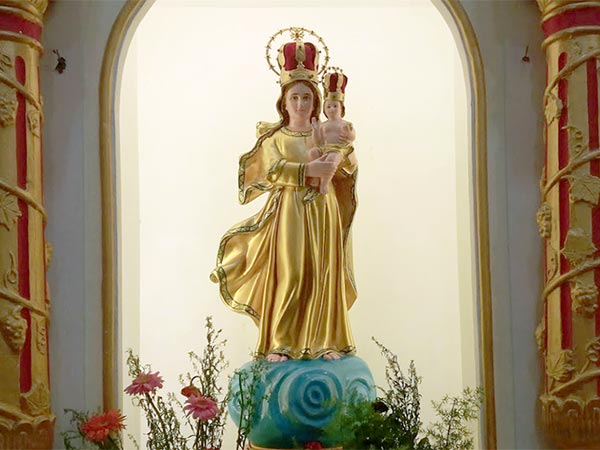
But the King of Mysore later took an act of horrible revenge on the Hindu revolutionaries but spared the Christians who had proved loyal to him. It was after this St.John de Britto visited Karumathampatty region, at least 3 times, as Superior 01 Madura Mission (1676 -83). The oral tradition says that he celebrated Mass in the main church, inside the fort. But this church was served by the Brahmin priests only while, there was yet another chapel outside the fort, served by a Pandara Swami for the low castes. St. John de Britto belonged to the latter category! In 1787, during Tippu’s wars, the rebuilt church was again destroyed. It was at that time, the theft of the artistically wrought iron gates of the church took place. But the Christians had saved and hidden the statues to save them from the invaders. The statue of Our Lady of Rosary, that is carried even today in procession during the Annual feast, is one of them, therefore one of the oldest statues of the diocese. In 178 3, the Paris Foreign Mission Society took the place, left orphaned by the suppression of the Society of Jesus in 1773, but partially by Portugal already in 1759 when all the missionaries of the Madura and Mysore mission were imprisoned, except 13, who had managed to escape arrest and they worked in our area, but died one after the -other due to old age except the one at Kovilpalayam, Fr.Pavone who visited Karumathampatty now and then. To fill in the void, the Pope asked the Paris Foreign Mission Society to step into the shoes of the Jesuits in 1783. In 1799 Tippu was defeated and killed. The region of Sathy, Coimbatore and Dharaputam mission, came under the British rule and thus also under the MEP Missionaries of Pondicherry.
Dharapuram was the capital of the Coimbatore District till 1819 when Coimbatore became the district headquarters. During Tippu’s persecution, the Christians had been scattered, some were killed, some imprisoned and taken as captives to Srirangapattnam (the capital) while many also had become Muslims, thus practically destroying the labour of the valiant Jesuits for over 150 years. It is reported that about 40 thousand had become Muslims because of Tippu’s persecution. If so, how many thousands more would have been Christians at that time? The Muslims of Mangalam and Puthur (near Tirupur) and Vaniputhur near Kodivery, must have apostatized then.
The interim period between the Jesuits leaving the mission and the actual taking charge of PME Fathers 1802, for about 40 years, the whole of Coimbatore and (Satbyamangalam) Kanuvakarai mission was a shepherdess. During this gap, at least 4 priests from Goa had sneaked into the orphaned areas, under the pretext of having jurisdiction, citing the privileges of the Padro ado, given by Pope Leo X as far back as 1514, claiming at least a sort of spiritual control over areas adjoining the Portuguese territories. They occupied many of our centres, especially of Karumathampatty province, places like Dharapuram, Aravakuruchi, Venkitapuram, Ooty, Athikode, Erithenmpathy, Palaghat etc.. challenged the. rights of the “Propaganda Missionaries” (as PME priests were known then) when they came to take ‘possession of these catholic centres. They vehemently opposed them. It created many scandals and.more confusion in the minds of the faithful, often leading to splits in the congregation, one party supporting the Goanese, the other Propagandists, and one writer of the time humorously adding “some wanting none of them so that they can live freely as they liked”.
There is an interesting history connected with this sad affair, known as the “Goanese Schism” or “Schism of Joachim”. Joachim, a butler- turned chief of the Christians of Ooty, was the Chief Patron of the Goanese priests. According to this tradition, it seems that the Devanga Community, supported the Propaganda missionaries and since they were the majérity, gave a lot of troubles to the Goan priest who was at Karumathampatty and that in anger, the Goan priests cursed the community before departing. This superstitious belief had affected the community so much that, they began to’ attribute every misfortune that fell them to the curse. And it is reported, that this Conimunity even petitioned Bishop Bardou (1874 - 1903) to obtain for them the Papal “forgiveness”, to free them from that course,and again, as late as 1964, when Pope Paul VI, visited Bombay (Mumbai), a delegation of Devangers presented a similar petition throu2h his secretary and received a favourable reply from Rome, through Bishop Savarimuthu on 17.7:1970.
It was in such a heartbreaking situation that the PME fathers started’ their work. Fr. Dubois, the famous missionary and writer was the pioneer to work in Coimbatore region between 1803- 1809, to search and bring back the scattered flock to the faith and to revive the church that was in utter ruin. In 1803 he could count only 3500 Catholics. He was revered by the whole of former Sathy mission and was called” The Great Prince of Mysore” or” The Prabhu of Karumatthampatty”. He was, the first to’ introduce • ‘Vaccination’ against Smallpox in India. It was ‘at Sankaragiri (in Salem Diocese now) that he started and trained his sacristan to perform the Vaccination. Thereafter, wherever he went, he continued this practice. That is how he came to be held in high esteem. He was assisted by four, Indian priests, the first fruits of the major seminary of Pondicherry, started with foresight in 1777 at Veerapattinam. The four Indian priests were Frs. Donat, Germanus, Aloysius ( Gnanapragasam) Loudovicus and Andreas.
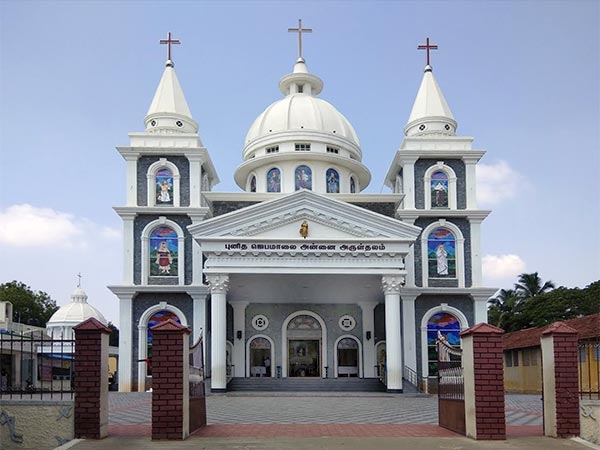
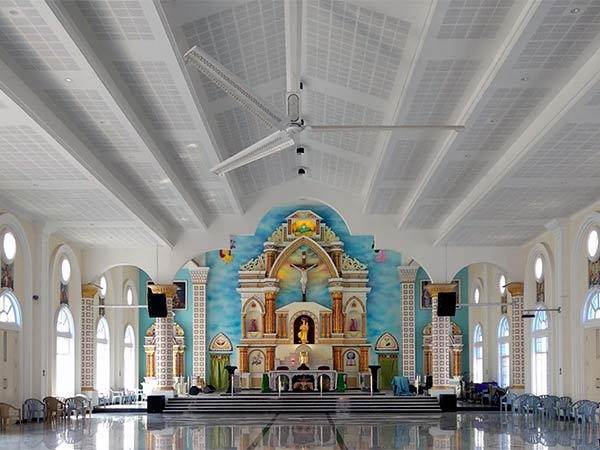
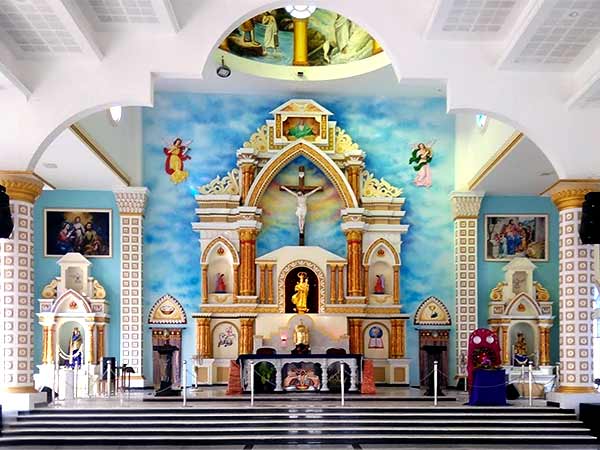
The church that existed till 1995, was planned and built by Fr. Dubois, helped by Fr. Ganapragasanathar, ‘the first of the Indian clergy, who was his assistant at Karumathampatty in 1803., He had obtained from the British government, not only the site of the old church (where it had stood within the fort) but also a large plot of land around it. After the departure of Fr. Dubois in 1809, once again our areas were without priests (MEP), as at Pondichery itself, they had only a handful of priests. The Goan priests became more active. Because of their love of money and Western Culture, the local Catholics disliked them. Finally, at the repeated requests by the Karumathampatty mission, priests, one or two, were sent from Pondy, but they had to retrace their steps, because of the Visa requirement. During the three month stay of the Indian Priest, Fr. Arulanandu, in 1836, a scandalous scuffle took place inside the church of Karumathampatty. It so happened that one of the Goanese priests’ from Dindigul had also arrived Karumathampatty on the same day as he. It must have been a real drama, though scandalizing when both of them tried to say Sunday Mass in the side church at the same time. When one priest tried to say Mass with his supporters, the opposite party would rush and put off the candles and vice versa. Finally, the Goan priest left in disgust and defeat, but the victories group celebrated their victory, by setting fire to the baggage of the Goan priest and surely it must have caused scuffle! Most probably, on hearing about this incident only, the collector would have demanded Rs. 500 as surety, so that no more such scuffles would happen! Fr. Arulanandu, moved by his native pride, refused to submit to this humiliating, condition, packed off to Pondy. Finally, Fr. Goust and Fr. Pacreau arrived with valid passports in 1836. Then in the next year, the zealous Fr. Bigot- Beauclair (Devapathinather) came and between 1837 - 1.845, visited all the Christian villages of the mission of Kannuvakrai, Ooty etc, and he built many chapels and presbyteries. When Coimbatore mission was raised as Pro-vicariate on 17.2.1845 by the Sacred Congregation of Propaganda, Msgr. Melchior Marie Joseph Marian de Bresillac was elected as Bishop, Karumathampatty was the mission headquarters. He was consecrated at Karumathampatty on 4.10.1846 on Karumathampatty feast day. Thus Karumathampatty became the headquarters and Residence of the new Bishop till he transferred his Residence to Coimbatore in 1850. The next Bishop Msgr. Godelle was also consecrated in this church on 16.08. 1857 since the cathedral of Coimbatore was under construction. In 1840 Fr. J. B. Barrot constructed the belfry. In 1902 Fr. J.B. Pierron built a long portico in front of the church. In 1908 Fr. Laphanne built the still eye-catching beautiful main, altar (mercifully still left intact). But the greatest vandalism struck this ancient historical place when the compound wall with its entrance, just similar to any old fort (perhaps it was what remained after the destruction of the ancient fort by Tippu) was pulled down in 1995. The frontal view was changed, under the good intention of the planers, to give the church an unhindered view from outside and also space to the extended church. In the old church of Fr. Dubois, the main aisle was extended east-west, pulling down the long portico with its third steeple and also the front portion of the compound wall with the main entrance. But thank goodness, they at least had the good sense to leave the main Altar, the sanctuary, and the cruciform side wings and the main belfry as the reminders of the 200-year-old church in all its past glory. Fr. Maria Mudiappan, had the distinction of remodelling and extending the church during 1995 - 96.
Information
Karumathampatty,
Coimbatore - 641 659